


Syllabus: GS3/Allied Sector
Context
- India’s agricultural progress is increasingly supported by the expansion of allied sectors such as livestock, dairy, poultry, and fisheries.
Allied Sectors in India
- Within allied agricultural activities, livestock and fisheries have demonstrated relatively stable growth rates of approximately 5-6 %.
- Between FY15 and FY24, the sector’s Gross Value Added (GVA) increased by nearly 195%, reflecting a compound annual growth rate (CAGR) of 12.77% at current prices.
- The dairy network encompasses:
- 22 milk federations, 241 district unions, 28 marketing dairies,
- 25 Milk Producer Organisations (MPOs), covering approximately 2.35 lakh villages and 1.72 crore farmer-members.
- India is strengthening value addition through the planned expansion of milk processing capacity to 100 million litres per day by 2028–29.
Significance of India’s Allied Sector
- Enhances Farmers’ Income: It provides supplementary and regular income unlike seasonal crop agriculture. It reduces dependence on monsoon-dependent crop production.
- Major Contributor to Agricultural GVA: Allied sectors contribute over 40% of Agricultural Gross Value Added (GVA).
- The livestock sector alone contributes around 30% of agri-GVA, making it a high-growth segment.
- Employment Generation: Labour-intensive sectors like dairy, fisheries, and poultry generate large-scale rural employment.
- Women Empowerment: High participation of women in dairy, poultry, and small livestock rearing strengthens SHGs and rural entrepreneurship, especially under cooperative models like Amul.
- Nutritional Security: It provides protein-rich food (milk, eggs, fish, meat, honey) and supports food and nutrition security goals, addressing malnutrition.
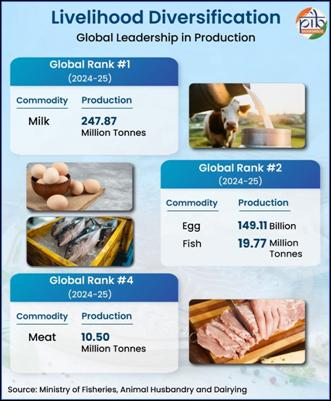
- Export Potential: India is among the top producers of milk and fish globally. The marine exports contribute significantly to forex earnings.
Concerns
- Low Productivity: Milk yield per animal in India remains lower than global averages.
- Fisheries and livestock productivity suffer due to poor breed quality and limited scientific management.
- Infrastructure Gaps: Inadequate cold storage, processing, and transportation facilities.
- Disease Outbreaks: Frequent livestock diseases such as Lumpy Skin Disease and avian influenza coupled with weak veterinary infrastructure and limited insurance coverage increase farmers’ vulnerability.
- Credit & Insurance Constraints: There is a limited access to institutional credit for small and marginal farmers.
- Climate Change Impact: Coastal fisheries are vulnerable to cyclones, sea-level rise, and ocean warming.
- Environmental Concerns: Overfishing and depletion of marine resources and methane emissions from livestock contribute to greenhouse gases.
Government Initiatives
- The National Livestock Mission promotes livestock-based entrepreneurship, improves breed productivity, and boosts production of meat, eggs, milk, and fodder.
- The Rashtriya Gokul Mission focuses on conserving indigenous bovine breeds, enhancing milk productivity, and making dairying more remunerative for rural farmers.
- The National Animal Disease Control Programme (NADCP) focuses on controlling Foot and Mouth Disease (FMD) and Brucellosis through 100% vaccination of cattle, buffalo, sheep, goats, and pigs.
- The Union Budget 2026-27 allocated a record ₹2,761.80 crore to fisheries, reinforcing sustained investment initiated under the Blue Revolution.
- Pradhan Mantri Matsya Sampada Yojana (PMMSY) promotes fisheries development through infrastructure, modernization, and value chain strengthening to boost production, exports, jobs, and fishers’ incomes.
- Pradhan Mantri Matsya Kisan Samridhi Sah-Yojana (PM-MKSSY), a sub-scheme of PMMSY, supports sector formalisation through insurance, credit, performance incentives, and traceability to improve income security and sustainability for fish farmers.
- National beekeeping and Honey Mission (NBHM): It is a Central Sector Scheme launched in 2020 under Atma Nirbhar Bharat Abhiyan for overall promotion and development of scientific beekeeping & to achieve the goal of “Sweet Revolution”.
- Mission-Driven Reservoir Development and Fisheries Value Chain Expansion: India possesses one of the world’s largest inland reservoir networks, spanning approximately 31.5 lakh hectares, which presents significant potential for expanding inland fisheries.
- Under Mission Amrit Sarovar, the Government of India has facilitated the development of 68,827 Amrit Sarovars, including 1,222 water bodies integrated with fisheries activities, thereby promoting fish culture, livelihood diversification, and the enhancement of aquatic ecosystems.
Conclusion
- The agriculture and allied sectors are not just about food production, they are the backbone of India’s economic resilience, social equity, and ecological sustainability.
- Strengthening these sectors is vital for achieving SDGs, ensuring inclusive growth, and making India Atmanirbhar (self-reliant).
Source: PIB
Previous article
US-Israel-Iran War
Next article
Missile Defence Systems
